
The 19 August 2026 development record described in my public lysimeter retrospective contains an uncomfortable combination: the plant HX711 sensor was not detected at startup, while plant mass was still published as 0 g. The communication update succeeded. That did not establish a valid mass measurement. Public retrospective
A reader seeing that number could reasonably ask: did the system measure a zero, or did it fail to obtain a reading?
That is the question I want to preserve from this stage of my MSc lysimeter work. A lysimeter helps investigate water balance; interpreting its mass record requires knowing what each reported value represents. This entry revisits documented engineering decisions rather than reporting a new experiment.
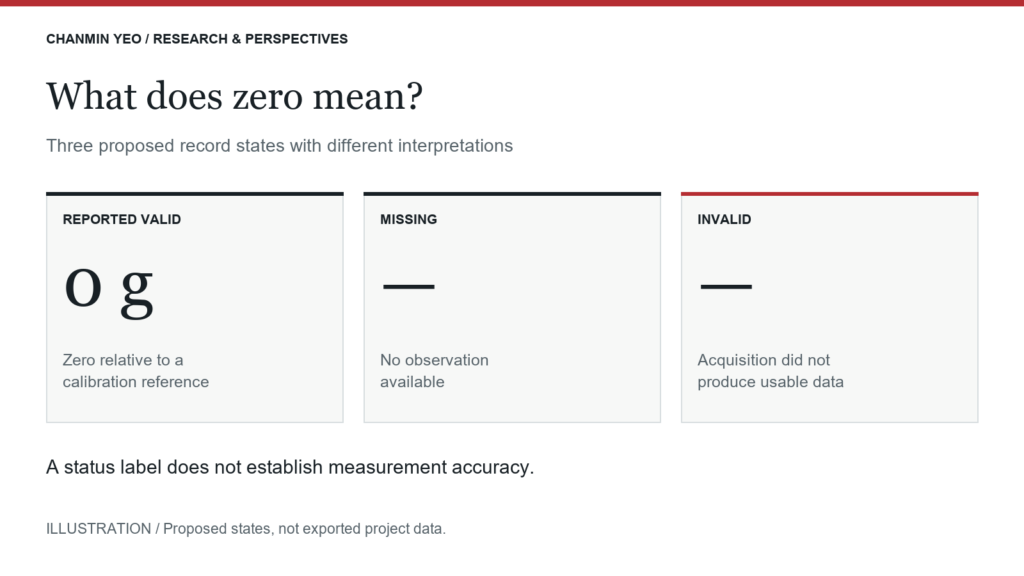
One number can hide several states
Consider the following proposed illustration, not an export of the project’s current data schema. Its purpose is to make a reader stop before interpreting a plotted point.
| Situation | Example value | Separate status | What a reader can infer |
|---|---|---|---|
| An acquisition reports zero relative to its calibration reference | 0 g | Reported valid | A zero was reported as usable; its accuracy still needs supporting evidence |
| No observation is available | No numeric value | Missing | There is no measurement to interpret |
| An attempted acquisition did not produce a usable observation | No numeric value | Invalid | The failed acquisition needs investigation |
Inserting a numeric zero into the last two situations would erase the distinction. On a mass plot, that substitution could look like a physical change. A later analyst might spend time explaining the plant or the load when the first question belongs to the acquisition path.
A failed database query is another state to keep distinct: failure to retrieve a record does not tell us whether the sensor measured anything. My notebook’s measurement guide treats these differences as part of interpretation.
Follow the value through calibration
Validity is only the first question. The public transition notes describe another boundary: ADS1256 mass values calibrated on the device had to bypass the older HX711 server scaling. Applying that legacy conversion again would change the meaning of the value.
For me, the useful design question is therefore specific: where does a raw signal become a value with a unit and calibration context? The answer needs to travel with the record. Changing hardware should prompt a check of that conversion path before values on either side of the change are treated as comparable. The documented decision is explained in Design decisions.
Ask which time the dashboard is showing
The measurement guide also distinguishes measurement time, message reception, aggregation and display. A fresh reception timestamp cannot make an older measurement new. Likewise, an hourly summary and the last raw sample answer different questions.
Before explaining a sudden point on a graph, I would want to recover its measurement time, its status and its calibration context. I would then check the intervention record: replacement, a zero or scale change, a restart, or movement around the platform may mark a boundary requiring investigation. This is a review sequence, not a diagnosis of the August incident.
Five questions to take to a data review
- Can a usable zero be distinguished from a missing observation and an acquisition failure?
- Which conversion produced the displayed unit, and could another conversion be applied downstream?
- Does the timestamp describe measurement, reception, aggregation or display?
- Which recorded interventions fall near the point being interpreted?
- Can the plotted point be traced to an identified record and software version?
These questions are the practical output of this note. They help define what to inspect before using a measurement in an explanation.
What the record establishes—and leaves open
The public retrospective describes selected internal records; the complete underlying logs are not public in this documentation edition. It does not establish the physical cause of the sensor-detection failure. Nor does this account demonstrate that every software path now handles every invalid state correctly, or that replacing the ADC improved accuracy. Those conclusions need identified tests and data.
My professor established the overall research direction. My detailed design and implementation, with AI assistance, are described in the notebook’s contribution statement. The linked sources use the fixed documentation version 5921ea5 so readers can inspect the basis of this account.
The next question I would bring to a measurement review is simple: when a value looks surprising, can we recover the evidence needed to interpret it?
한국어 요약
공개 회고록에 따르면 2026년 8월 19일 기록에는 식물용 HX711 센서가 부팅 시 감지되지 않았지만 질량은 0 g으로 전송된 상황이 나옵니다. 통신 성공만으로 측정의 유효성이 확인되지는 않습니다. 이 글은 0·누락·무효를 구분하고, 보정 경계·시각·개입 기록을 함께 확인하는 질문을 제안합니다. 표는 설명용이며 현재 구현의 검증 결과가 아닙니다. 센서 미감지의 물리적 원인이나 ADC 교체의 정확도 향상은 이 기록으로 확정하지 않습니다.
Sources and scope
- HX711–ADS1256 retrospective: the dated incident, transition history and evidence limits.
- Design decisions: validity and conversion responsibilities.
- Measurement and quality: timestamps, interventions and missing-data interpretation.
This article introduces no new measurements, software tests or performance estimates.